MRI Certificate Program

b01-scaled


The School of Health Sciences offers an accredited second-discipline 27-credit hour certificate in Magnetic Resonance Imaging (MRI). It is available to:

  • Current fourth-year BHSc students in Diagnostic Medical Ultrasound, Nuclear Medicine Technology and Radiological Technology;
  • Post-diploma BHSc students in Diagnostic Medical Ultrasound, Nuclear Medicine Technology, or Radiological Technology who wish to pursue the MRI certificate as part of their BHSc degree;
  • School of Health Sciences Alumni from programs of Diagnostic Medical Ultrasound, Nuclear Medicine Technology and Radiological Technology;
  • Graduates of Canadian accredited degree programs in Radiological Technology and Nuclear Medicine Technology (Applications from current Canadian entry level students in the final year of their degree program in Nuclear Medicine Technology or Radiological Technology may be considered on condition of proof of successful completion prior to the beginning of classes in the MRI Certificate program.);
  • Canadian certified/licensed Imaging Technologists in Diagnostic Medical Ultrasound, Nuclear Medicine Technology or Radiological Technology who may choose to complete the certificate in magnetic resonance imaging as a stand-alone certificate.

The MRI Certificate Program may be completed in as little as 14 months (10 months part-time/online studies, 4 month clinical placement). Courses must be completed in a prescribed sequence. Please review our MRI Curriculum webpage for further details.
Students may apply their MRI Certificate program credits towards a Post-Diploma BHSc degree in one of the diagnostic imaging disciplines.

How does MRI work?

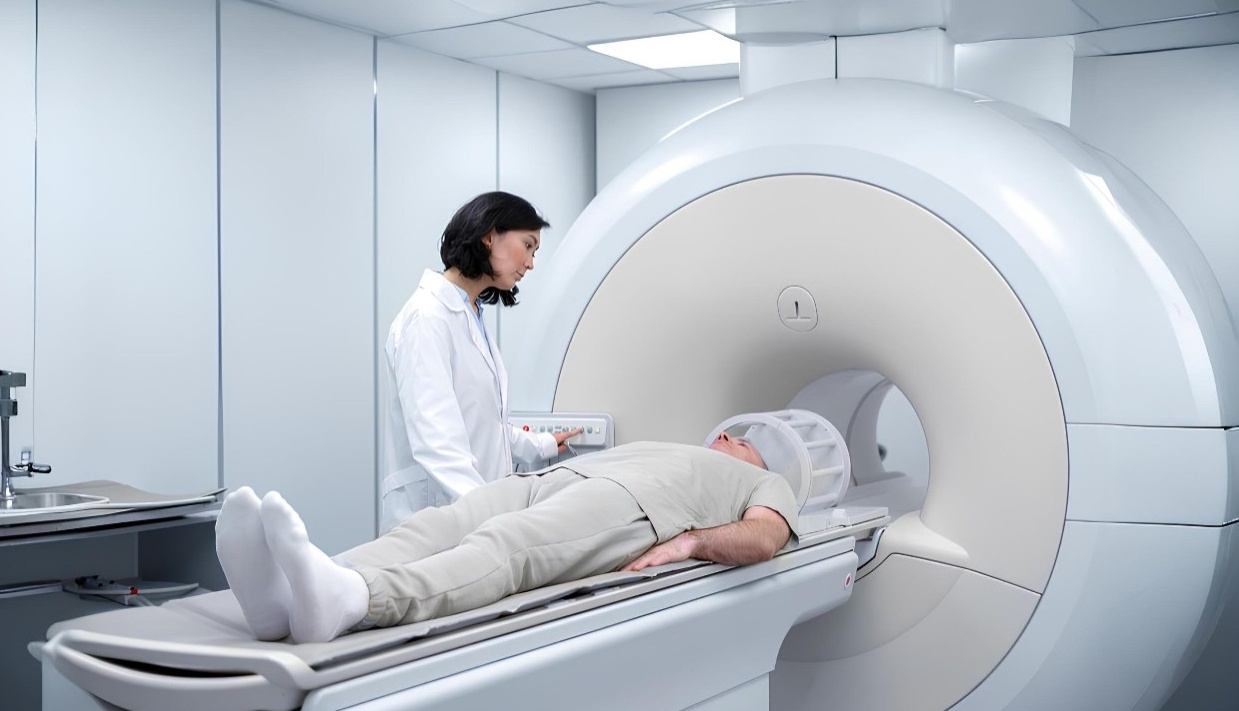
Magnetic Resonance Imaging (MRI) Technologists are highly skilled health care professionals who use powerful magnets, radio waves, and advanced computer technology to create detailed images of the inside of a patient's body.

Contrary to popular belief, there are no X-rays used in an MRI. In the MRI scanner, hydrogen atoms in the patient’s body are exposed to a strong magnetic field. A radiofrequency pulse is then used. When the pulse is turned off, the atoms give off energy signals that are measured by a computer. The computer processes these signals to create detailed images of human anatomy.

MRI technology is known for producing extremely detailed images. An MRI is better at capturing the small features between similar structures. For instance, it can easily show the difference between the white matter and gray matter in your brain and spinal cord, whereas a CT scan is not as detailed. Because of this, an MRI will be chosen when looking for small structures or when images of finer detail are needed.

MRI Technologists ensure patients are positioned safely and comfortably, monitor them throughout the examination, and work closely with radiologists, who interpret the images and use them to make a diagnosis.


Applying to the MRI Certificate Program

The MRI Certificate program is designed for certified Imaging Technologists who wish to further their education and complete a certification in a new modality. The MRI Certificate program is open to current BHSc students in the diagnostic imaging disciplines (DMUT, NUMT, and RADT), or to licensed graduates of other accredited diagnostic imaging programs.

The MRI Certificate is not direct-entry or intended for individuals without prior education/experience in diagnostic imaging. Individuals in this category should refer to the 4-year BHSc program.

Current BHSc Students in DMUT, NUMT, or RADT

Students enrolled in the BHSc programs in Diagnostic Medical Ultrasound, Nuclear Medicine Technology or Radiological Technology may apply internally to the School through the MRI advisor. Current BHSc students must have:

  • Cumulative GPA of 3.3
  • B+ or higher in discipline specific-physics (HSCE 2020 or DMUT 2020)
  • Approval of a completed safety screening form
  • Proof of current CPR-HCP and Standard First-Aid

Current BSHc students who pursue the MRI certificate will complete courses/credit hours in addition to their normal degree requirements. Entry-level students in NUMT and RADT will complete 12 credit hours beyond the degree requirement and DMUT students will complete three credit hours beyond the degree requirement.

Completion of the MRI certificate will require students enrolled in a degree program to study beyond the usual 4-year time frame.

Current/Licensed Imaging Technologists

Certified/licensed Imaging Technologists should also apply directly to the School of Health Sciences MRI advisor. Admission requirements are:

  • External applicants and students enrolled in the SHS post-diploma program must contact the MRI advisor prior to submitting an application to determine if a Prior Learning Assessment (PLA) is required.
  • Successful completion of program accredited through Accreditation Canada in a medical imaging discipline of diagnostic medical ultrasound, nuclear medicine technology, or radiological technology. (Applications from current Canadian entry level students in the final year of their degree program in Nuclear Medicine Technology or Radiological Technology may be considered, on condition of proof of successful completion prior to the beginning of classes in the MRI Certificate program.)
  • Currently licensed to practice by the Canadian Association of Medical Radiation Technologists (CAMRT) in the fields of nuclear medicine technology or radiological technology, OR
  • Licensed/registered in good standing with provincial college/regulatory body within Canada in the medical imaging field of diagnostic medical ultrasound

School of Health Sciences’ Alumni and external applicants who have been accepted into the program, but are not currently enrolled with , are also required to submit an application for admission to the University as a “Special Undergraduate” under the Faculty of Health before declaring the certificate through DalOnline.

External applicants must submit the following documentation:

  • Official transcript of diploma or degree program and/or licensure;
  • Current registration number with CAMRT or applicable provincial college (or copy of license/certification);
  • Letter of Intent
  • Resume (contact references may be requested after review of application)

Guidelines for Letter of Intent: This letter provides the opportunity for applicants to expand upon their experience, any advanced or specialty education they may have and their interest in undertaking university studies or pursuing a certificate in MRI. Information to include:

  • Work experience and/or education;
  • Educational initiatives undertaken since diploma/degree completion (if applicable);
  • How applicant thinks this program will contribute to the professional development;
  • Personal and professional motivation
  • Readiness for university education in MRI studies


Upon approval from the MRI Advisor/Admissions committee, students must enroll in the Certificate in Magnetic Resonance Imaging.  To enroll, students must declare the certificate through Dal Online (https://dalonline.dal.ca > Web for Students > Admissions > Declare Major/Minor/Certificate).

To graduate with the Certificate, students must apply to graduate with a Certificate per the timelines determined by the Registrar's Office.

How do I apply to the MRI Certificate program?

Interested applicants should begin the application process by connecting with the MRI Faculty Advisor.

When can I apply for the MRI Certificate program?

Applications for the MRI Certificate program have a deadline of March 1st for a program start in late June/early July.

Can I apply to the MRI Certificate program if I’m not from Nova Scotia?

Yes. Students from outside Nova Scotia can complete the entire academic portion of the MRI Certificate Program virtually. The School of Health Sciences will work with clinical sites to support student placements; however, placement agreements outside the Maritime provinces are limited and subject to availability. Students whose participation in the program is sponsored by their employer will typically complete their clinical placement at their workplace.

When do courses start? Can I enroll to start in January?

Intake for the MRI Certificate program occurs only once a year, with courses beginning in late June/early July.

Can the MRI Certificate be completed virtually/at a distance?

Yes. The academic portion of the MRI Certificate (~10 months) is completely virtual. The 4-month clinical portion must be completed at a clinical site, in-person.

Can I complete the MRI Certificate on a part-time basis?

Yes. The academic portion of the MRI Certificate (~10 months) is on a part-time basis. The 4-month clinical portion is full-time.

I have a previous healthcare degree in a different discipline. Am I eligible for the MRI Certificate?

The MRI Certificate is not direct-entry or intended for individuals without prior education/experience in diagnostic imaging. Individuals in this category should refer to the 4-year BHSc program.


Requirements of the Profession

Statement of Fitness
The Health Professional courses in the School of Health Sciences are intellectually, emotionally, and physically demanding.  As a potential applicant, it is important that you familiarize yourself with the performance expectations and requirements to practice safely and competently before applying to the program, so you can asses your own ability to meet the career requirments. See [PDF -15 KB]

Accreditation

Accreditation Canada is the program's accrediting body. Further information can be found on , including a list of all accredited Nuclear Medicine Technology programs within Canada.

Professional Associations

is the national professional body for MRI Technologists.

 (formerly known as NSCMIRTP) is the Provincial Regulatory Body for MRI Technologists in Nova Scotia.

Registration is required to practice professionally, and members must undergo continuing professional development to maintain active registration.