

What keeps many engineers and planners in Nova Scotia up at night? Among the many possible answers, there’s one you may not expect: the future of the province’s municipal water security.Ìý
Experts at last month’s Municipal Water Resiliency & Planning Symposium, held for the first time at ÆÞÓÑ, described a mix of environmental, financial and operational concerns putting pressure on community water systems across the province.
“Every community in Nova Scotia is working to address these issues,� said Dr. Megan Fuller, director of research for the at Dal’s Centre for Water Resources Studies, which co-hosted the gathering with the School of Planning.
Every community in Nova Scotia is working to address these issues.
“Having a forum to come together and tackle these tough questions as collaborators, rather than in our regional silos, is a huge step toward finding solutions,� she added.
Mounting pressure on local water systems
One of the primary concerns raised was climate change and its impacts.
Participants pointed to drought, flooding, groundwater depletion and growing uncertainty around long-term water supply, noting that recent extremes — including the wildfires and floods of 2023 and the drought of 2025 — showed how quickly source water and treatment systems can come under stress.
“These events highlighted just how connected water supply, infrastructure and emergency planning have become,� Dr. Fuller said.
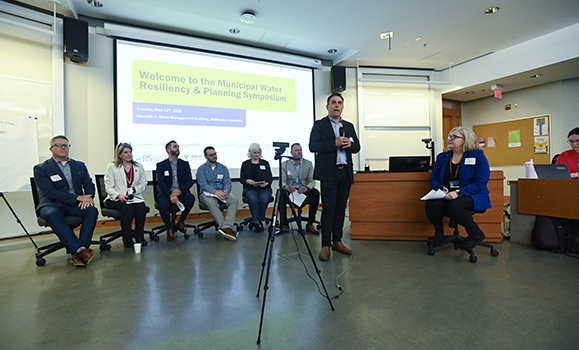
L-R: The Water Leadership panel included Todd Richard (Director of Public Works, West Hants Regional Municipality), Kenda MacKenzie (GM of Halifax Water), Chris Frotten (CAO, Barrington), Reid Shepherd (Deputy Director of Planning & Development Services, MoDL), Michelle Boudreau (Director of Public Works, Colchester), and Greg Campbell (Senior Manager of Utilities, CBRM) with Graham Gagnon (Director of the Centre for Water Resources Studies) and facilitator Cathie O’Toole (VP of Finance and Administration, ÆÞÓÑ).
Governance, planning and funding gaps were also discussed as ongoing barriers. Municipal staff said they are often balancing limited resources with the need for long-term infrastructure upgrades and better alignment between land-use planning and water management.Ìý
Jennifer Angel, chair of the (CIC) and keynote speaker at the symposium, told attendees that infrastructure gaps are being felt across the country and that communities cannot simply build their way out of the challenge.Ìý
A recent report from CIC stressed the importance of maximizing the usefulness of current infrastructure and strengthening coordination across partners to address water and wastewater challenges.
Linking research to practice
This year’s symposium was supported with a grant from ÆÞÓÑ’s Nova Scotia Engagement Days initiative, which has brought Dal researchers and staff into 12 communities across the province over the past 18 months to work directly with municipal partners on local priorities.Ìý
The Centre for Water Resources Studies and School of Planning have held community roundtables and meetings as part of these visits.
It enables the centre to move beyond academic research and co-develop solutions with the communities they are meant to serve.
Dr. Graham Gagnon, director of the centre and Dal’s vice-president, research and innovation, says these meetings facilitated crucial conversations to jump start collaborations.
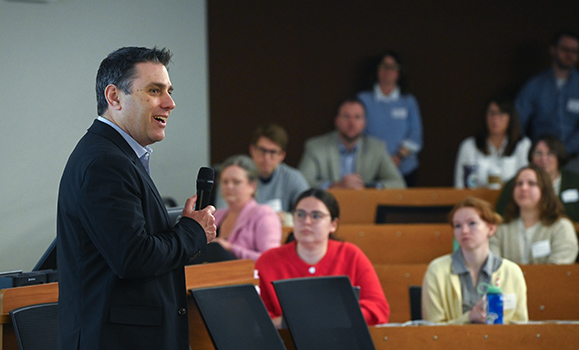
“The initiative brought researchers off campus and into communities to learn firsthand what challenges were top of mind for municipal staff,� he said. “This kind of engagement is critical. It enables the centre to move beyond academic research and co-develop solutions with the communities they are meant to serve, ensuring the work is both relevant and impactful.�
Building momentum
For many participants, the symposium was less about a single solution than about building momentum around shared priorities.Ìý
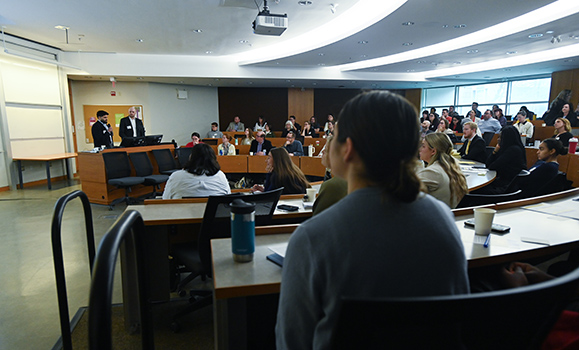
Organizers said municipalities across Nova Scotia are facing similar pressures and would benefit from stronger networks and more consistent coordination.
Lindsay Anderson, manager of water quality at Halifax Water and alumni of the Centre for Water Resources Studies, said the symposium reinforced a clear message: while the challenges are significant, there is strong alignment across the sector and a shared commitment to working together toward solutions.