
Behind the Lecture pulls back the curtain on some of Dal’s most compelling courses, offering a closer look at the ideas and people that shape them.
With the rise in natural disasters all around the world, there’s a growing urgency among experts to raise awareness of the looming environmental hazards of our planet, what causes them, and how they can be prevented.Â
That is exactly what does. The first-year ÆÞÓÑ course covers a wide range of disasters, from volcanic eruptions, tornadoes, and meteorite impacts.Â
Dr. John Gosse, professor with the Department of Earth and Environmental Sciences, launched the course in 2003 and continues to teach it to this day. He says interest in the class has grown over the years as people have become more aware of natural disasters and their impacts, noting the wide variety of students who are drawn to it.Â
“That’s one of the reasons I love teaching this class,â€� he says. “ÆÞÓÑ one third of the class is science, another third are arts majors, and then the rest are a mixture. It’s a wide spectrum of our campus who take it.â€�
The course is unique in that it can take disasters happening in real time and apply them to the course material, which Dr. Gosse notes is one of the students’ favourite parts of the course.
“Natural hazards happen every day of the year. If there’s something significant happening in Canada, or really devastating globally, we will use those events to talk about the hazard, what caused it, and whether there were any predictions or monitorings of it during its course,� says Dr. Gosse.
Suggest a course for Behind the Lecture
Is there a course that changed how you see the world — or one more people should know about?
Students, faculty and staff are invited to share suggestions for future Behind the Lecture articles.
The course provides virtual opportunities for students to experience and see real-life natural disasters after they have happened. During a lecture, Dr. Gosse walks students through past field sites in the Himalayas, Andes, western US and Canada. He also goes over lab research that he and his group have worked on, all the way from earthquakes to tsunamis to floods.
If there’s something significant happening in Canada, or really devastating globally, we will use those events to talk about the hazard and what caused it.
As part of the course, students are provided experiential learning opportunities through Google Earth assignments, a tool that Dr. Gosse uses in his own research. The software allows students to see things from an angle they wouldn’t normally get to see.
“You can conform the software to the way you want to see things. We virtually visit hazard sites around the world. You can see lava extruded from a volcano. It allows you to go underneath the surface of the ocean to view earthquake faults and submarine volcanoes. We can track tsunamis across the ocean and the damage,� says Dr. Gosse. “We’ve improved the Google Earth assignments every year to get a set of assignments that are hopefully challenging and fun.�
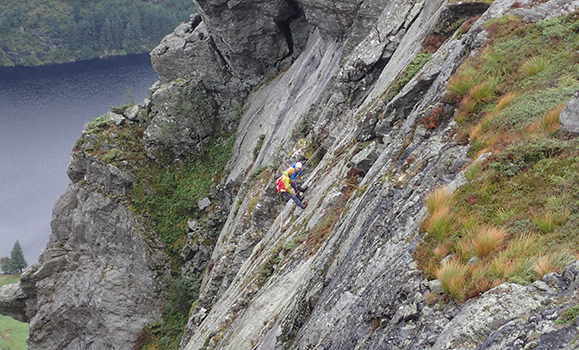
Dr. Gosse and CRISDal researchers using isotopes in the rocks on the cliff face to estimate the date of a landslide that occurred thousands of years ago.
Informing the next generation
Dr. Gosse hopes that students will walk away from the course with a different understanding of the world around them.
“They’ll learn to see Earth as one connected system,� he says. “The sun and the heat inside the planet both help drive natural hazards. These forces can move tectonic plates, control atmospheric dynamics, and affect ocean circulation, sea ice and volcanic activity. They’re all tied in, and they all change the way that hazards occur in our beautiful, but very complex Earth.�
We’re all part of this planet, and we have a role to make sure we’re aware of natural hazards and make good decisions.
Students taking the course may choose very different pathways in the future, but Dr. Gosse hopes each takes a bit of his course with them. Many students write back years later to describe an earthquake they just experienced or share a photo of a volcano they are exploring.
“We’re all part of this planet, and we have a role to make sure we’re aware of natural hazards and make good decisions.�